Botany Blog Plants of the Northeastern U.S.

June 20, 2010

Squarrose Sedge

Filed under: North American Native Plants — admin @ 21:31

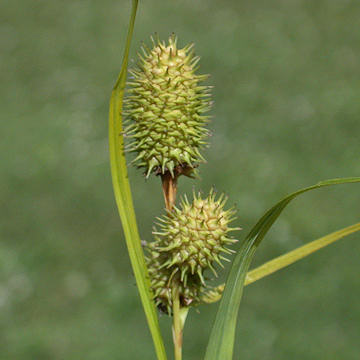
Squarrose Sedge (Carex squarrosa) is a sedge of swampy woods and thickets that can easily be identified in the field. A stout, tufted sedge that can grow to a height of nearly 1 m, it has inflated perigynia (sacs) with abruptly narrowed beaks that are tightly packed on 1-2 (sometimes 3) spherical to ovoid spikes. The term squarrose means spreading, referring to the arrangement of the perigynia on the spike. The persistent style of the achene has a distinct bend to it, distinguishing it from the straight or slightly curved style of Cattail Sedge (Carex typhina).

Carex squarrosa

June 4, 2010

Mullein

Filed under: Naturalized Plants — admin @ 00:24

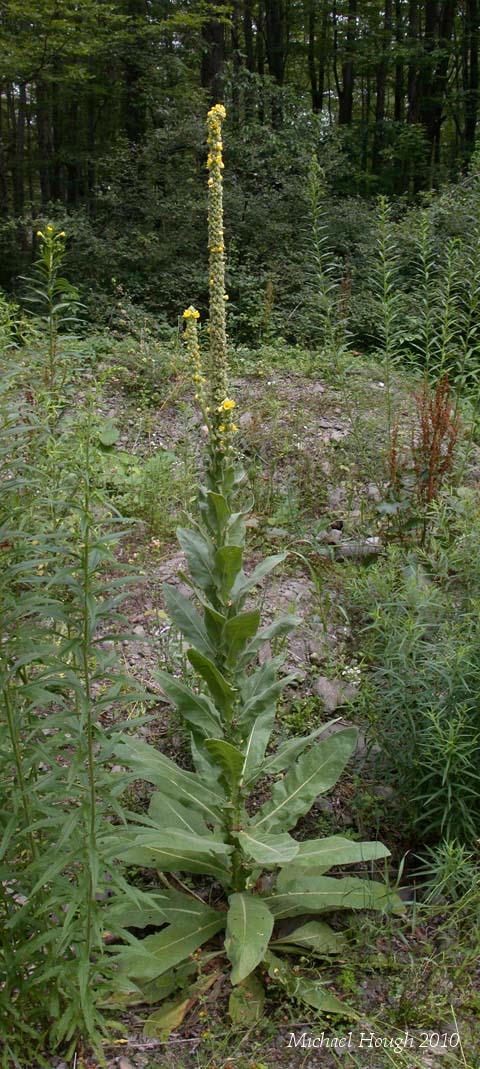
Below is a composite image of Common Mullein (Verbascum thapsus). This species has naturalized throughout most of temperate North America and typically occurs in disturbed areas. It is a biennial, most easily recognized by the low rosette of densely fuzzy leaves in the fall of the first year or spring of the second year. By summer of the second growing season it sends up a tall, dense spike of yellow flowers. Mature flowering stems can reach 2 meters in height.

 Common Mullein

May 10, 2010

Spinystar

Filed under: North American Native Plants — admin @ 23:34

Many years ago I developed a fascination with cold-hardy cacti. There are several Opuntia spp. (Prickly Pears) that naturally occur in the Midwest and one in the Northeastern U.S. (Opuntia humifusa).

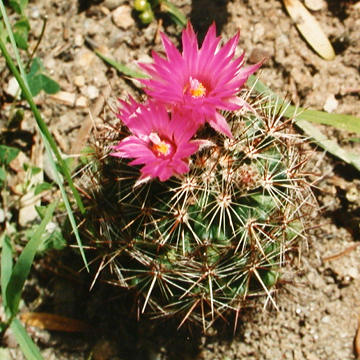
Spinystar (Coryphantha vivipara) is quite different and only occurs as far east as Minnesota. It has bright magenta flowers and a single, cylindric stem. This species can be grown in the Northeast but may develop rot near the base if it is allowed to get too wet, particularly during cold weather. This is probably what naturally limits its range to the west.

Spinystar

May 6, 2010

Large White Trillium

Filed under: North American Native Plants — admin @ 00:38

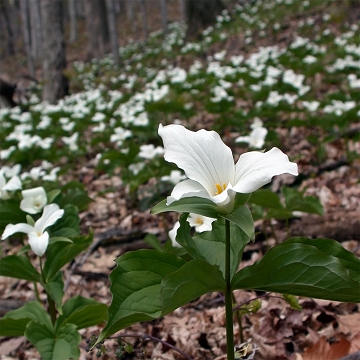
The spring ephemerals are really brightening up the woods now. We are fortunate in central NY to have many calcareous woodlands boasting large populations of large white trillium (Trillium grandiflorum).

Trillium

All trilliums are protected in New York State because they are considered exploitably vulnerable.  Plants are considered to be exploitably vulnerable when they are “likely to become threatened in the near future throughout all or a significant portion of their ranges within the state if causal factors continue unchecked” (NYCRR §193.3). While it may seem unnecessary to protect a plant that can be locally abundant, this and other trilliums are often lacking in forests with a history of disturbance, particularly forests that have established on formerly cultivated land.

References:

New York State Register and Official Compilation of Codes, Rules and Regulations of the State of New York (NYCRR) http://www.dec.ny.gov/regulations/regulations.html


May 3, 2010

Perigynous flowers

Filed under: Uncategorized — admin @ 22:16

Flowers can be characterized based on the position of the ovary in relation to the other parts of the flower. When the floral parts arise from a position below the ovary, the flower is said to be hypogynous (hypo=below; gynous=female) and the ovary superior since it is above the point where the other floral parts are inserted. When the floral parts arise from a position above the ovary, the flower is said to be epigynous (epi=above) and the ovary inferior since it is below where the other floral parts are inserted.

There is another, special case of an inferior ovary where the bottom of the sepals, petals, and stamens are fused into a cup around the ovary called a hypanthium, or floral cup. Such a flower is termed perigynous (peri=around), because the hypanthium surrounds the ovary. The presence of a hypanthium is a characteristic feature of some families of plants, particularly the Rosaceae and Grossulariaceae. I had a few minutes to kill today and decided to dissect a hyacinth flower that was in the lab and to my surprise found that Hyacinthus orientalis also has a perigynous flower. Here is a closeup of an entire flower
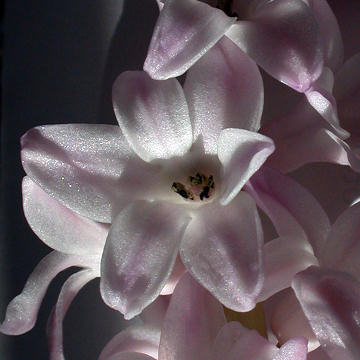
Common Hyacinth

Flower cut in half longitudinally (below)
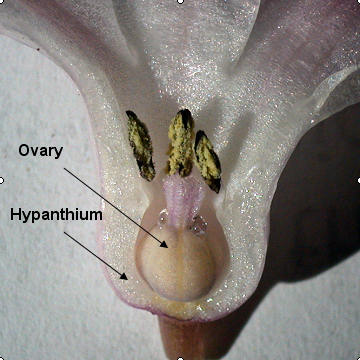
Perigynous flower

One last image after the ovary was removed so that the insertion of the stamens at the top of the hypanthium is more clearly visible. Also note the drop of nectar near the base of one of the filaments.
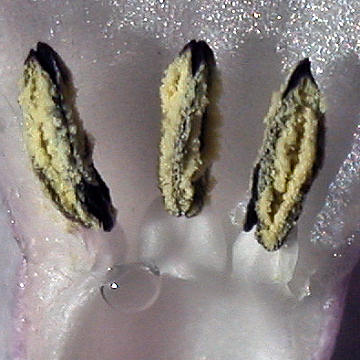
Hypanthium

April 24, 2010

Dendroid Moss

Filed under: North American Native Plants,Seedless Plants — admin @ 23:36

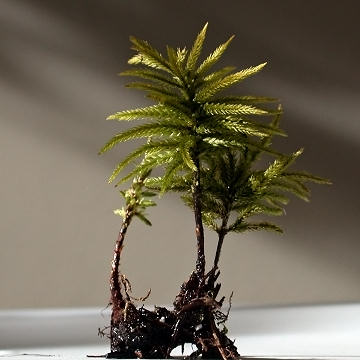
Climacium dendroides, or Tree Moss, is one of the largest mosses found in North America. Often found in dense stands, it is also one of the most attractive mosses when wet.

Climacium dendroides

April 18, 2010

Seedless Plants

Filed under: Seedless Plants — admin @ 02:44

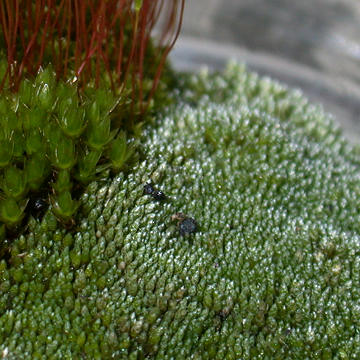
I recently added an index of seedless plants to the database of plants on Plants of the Northeastern U.S. This is intended to make it easier to find pages related to ferns, horsetails, clubmosses, mosses, and liverworts. There are still quite a few mosses to be added, including Bryum argenteum (below).

Bryum argenteum

This species is easily identified as it grows in very short, dense colonies and has a silvery overall appearance. It is common in dry, open areas like driveways and sidewalks.

April 15, 2010

Chara gametangia

Filed under: Algae — admin @ 22:18

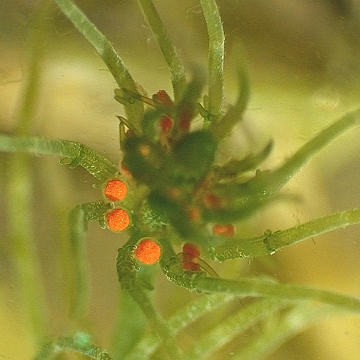
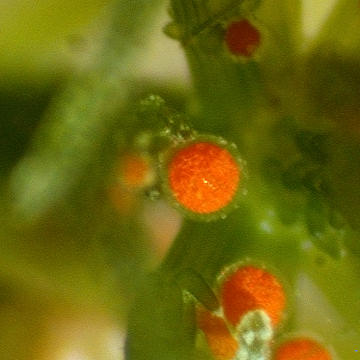
Earlier this spring I collected some samples of algae for my botany class to observe and managed a small sample of Chara, also known as muskgrass, to put in the lab. It has been growing well with frequent water changes and has developed lots of the reproductive structures called gametangia (structures that produce gametes, or sperm and eggs). The type of gametangia that produce sperm are called antheridia and are seen as the bright orange structures in image below.

Chara antheridia

And here is a closeup of an antheridium

Chara antheridium

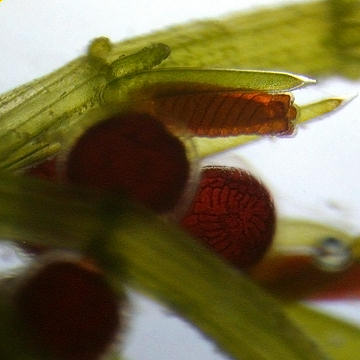
 Somewhat less abundant are the oogonia, where eggs are produced and where fertilization takes place.  The oogonia on this particular specimen have an interesting twist to them, although I do not know if this is typical of all Chara spp. or just this one.

Chara gametangia

April 11, 2010

Moss Antheridia

Filed under: Seedless Plants — admin @ 18:06

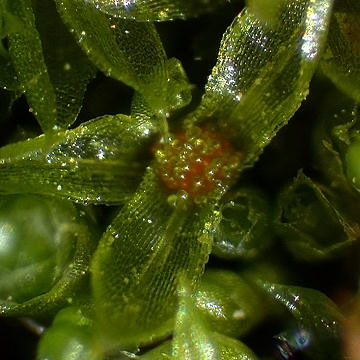
This is a closeup of a moss shoot tip bearing a slash cup filled with antheridia (male reproductive structures). The function of the splash cup is to use the momentum of rain drops to disperse the sperm contained within the antheridia.

Splash Cup

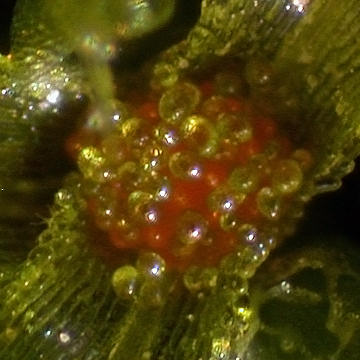
And here is a closeup of the interior of the splash cup.

Antheridia

April 10, 2010

Red Maples in Bloom

Filed under: North American Native Plants,Uncategorized — admin @ 00:35

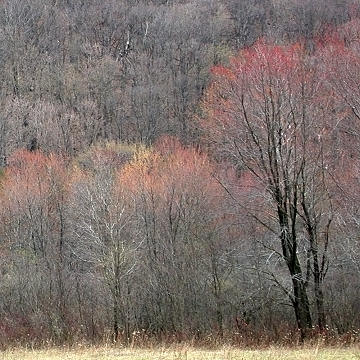
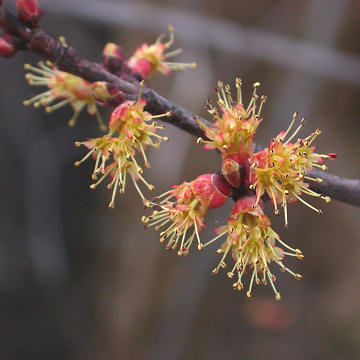
One of the more attractive trees in flower now in central NY is red maple (Acer rubrum). It is common in acid woodlands and swamps and has perfect flowers that range from yellow to red.

Red Maple

Red Maple Flowers

« Newer PostsOlder Posts »

Powered by WordPress